Unconventional Ways to Get Outside
Activities anyone can enjoy, that don't require you to sweat or have a full wardrobe from REI.
Being “outdoorsy” is often synonymous with rugged individuals who only wear Goretex and drive a Subaru. That is simply not the case. You can enjoy the outdoors in any way you please, and so long as you are spending time in nature you’re an “outdoorsy” person in my book. Spending time outside doesn’t always have to require an agenda or a pack list.
Here are some of my favorite ways to spend time outside that don’t involve sweating, a high-tech backpack, or the cardio fitness level of a triathlete.
Birding
Think of birding like pokemon for adults. It has minimal investment requirements, and you can do it basically anywhere. I’ve actually seen some incredible birds on a walk through a local city park. Birds are miraculously everywhere, so you’ll have no trouble finding some.

Photo by Joshua J. Cotten on Unsplash
Getting Started
My recommended starter kit for this activity is the Merlin Bird ID App, and a set of binoculars. Don’t feel like you need to shell out $$$ for good glass. Any pair will do to start. If you ever feel the need to upgrade, I’m currently loving my Vortex Diamondbacks, which are around $250.
The Merlin Bird ID App is INCREDIBLE and so helpful no matter what stage of your birding journey you’re in. This fancy app (created and run by Cornell Lab) is free, and can help you identify birds via sound, photo, or manual ID through a step-by-step process of elimination. Additionally, if you pair this with ebird you can keep track of all the birds you find over time. Your birding reports contribute to hundreds of conservation decisions and peer-reviewed papers, thousands of student projects, and help inform bird research worldwide. Collecting pokemon AND helping others? Literally, nothing better.
Bring the Kids!
Birding is a wonderful activity to not only help you become more familiar with your local wildlife population, but it can also be a great way to entertain kids and get them outside. Give them a small printout of some local birds in your area and take them for a walk where they have to try and spot the birds. Kind of like car bingo, but birds.
Sketching
While you may believe you need to be artistically inclined to do this activity, you do not. Nope. Not one bit. You can be the best stick figure artist out there, or Michelangelo. Art is for all, no matter the skill level, and it is also a great way to spend time outdoors.

Photo by Daniel Houwing on Unsplash
Here’s how you can enjoy the outdoors artistically:
Loosely draw a scenic point of view
Document new plants you see on your hike
Create a “map” of your adventure with doodles, dotted lines, and fun moments
Sketch animal tracks or nests you find
Draw the same tree from multiple angles
Record seasonal changes in a familiar spot
Sketch tide pools and their contents
Draw the texture of different bark types
There are many ways you can get out and create art while being immersed in nature. For me, it is one of my favorite ways to enjoy the outdoors. I love trying to get little sketches of places I visit as I often find myself recollecting the moments and feelings that surrounded that snapshot in time. It’s a fun way to memorialize your adventures.
Beachcombing
This is an activity I often don’t think of as an activity at all, or even something adventurous. It is by far one of the easier activities to get into and certainly one of the most relaxing.

Photo by Pete Godfrey on Unsplash
With the continuous tide cycle a beach will always contain something new on the shoreline — shells, sea glass, driftwood, feathers, crab molts, and maybe something genuinely unexpected. It’s one of the most naturally rewarding outdoor activities because the beach does all the work. You just walk slowly and look down. Much better than looking down at your phone all the time.
Getting Started
You need nothing to start. I suggest wearing shoes you don’t mind getting wet and a bag for collecting anything cool (or trash). Low tide is the best time to comb. Not sure when low tide is for your area? Check a free tide chart app like Tides Near Me before you go. Storm beaches and remote stretches tend to yield more interesting finds than heavily trafficked areas. If you want to go deeper, a basic field guide to shells or coastal nature for your region will help you identify what you’re finding and make the whole experience more interesting over time.
Bring the Kids!
Kids are natural beachcombers. Give them a simple checklist — a piece of sea glass, a shell with a hole in it, a feather, something alive — and let them race to find each one. The iNaturalist app is great for identifying crabs, birds, and anything unusual they come across.
Leave No Trace
Leave shells with living animals in them where you found them. Avoid disturbing nesting areas marked on the beach, and pack out whatever you brought in. Take only empty shells, sea glass, rocks, and driftwood — and check local rules, as some protected beaches restrict even that. Try not to carry out the whole beach, and limit your collection to just a few items. Bonus points if you do take home trash or even sea glass (which is technically a trash turned treasure).
Stargazing
On a clear night away from city lights, you’ll find our great big sky is a beautiful, free experience to enjoy and has been here for the entirety of human existence. From meteor showers to planetary alignments, the sky at night is a wonderful thing to behold. You can make this activity as complicated or as simple as you’d like.

Photo by Mark de Jong on Unsplash
Getting Started
Find a dark place away from light pollution. If you live in a city or busy urban environment, you may need to travel a few miles until the lights no longer obscure your view of the night sky. Once you’ve found a location, give your eyes 20 minutes to adjust to the dark before you decide the sky is unimpressive. Humans have pretty decent night vision, but with the amount of time we spend on phones it does take a bit to adjust to low lighting conditions.
The free app Stellarium lets you point your phone at any part of the sky and identify exactly what you’re looking at in real time — constellations, planets, satellites, and more.
Bring the Kids!
Start with the moon and planets as they’re the most immediately impressive and easiest to find. Level up with a printed star chart and challenge them to trace a constellation on their own. Meteor showers are a particular hit; check American Meteor Society for upcoming events and plan a late night around one.
Mothing
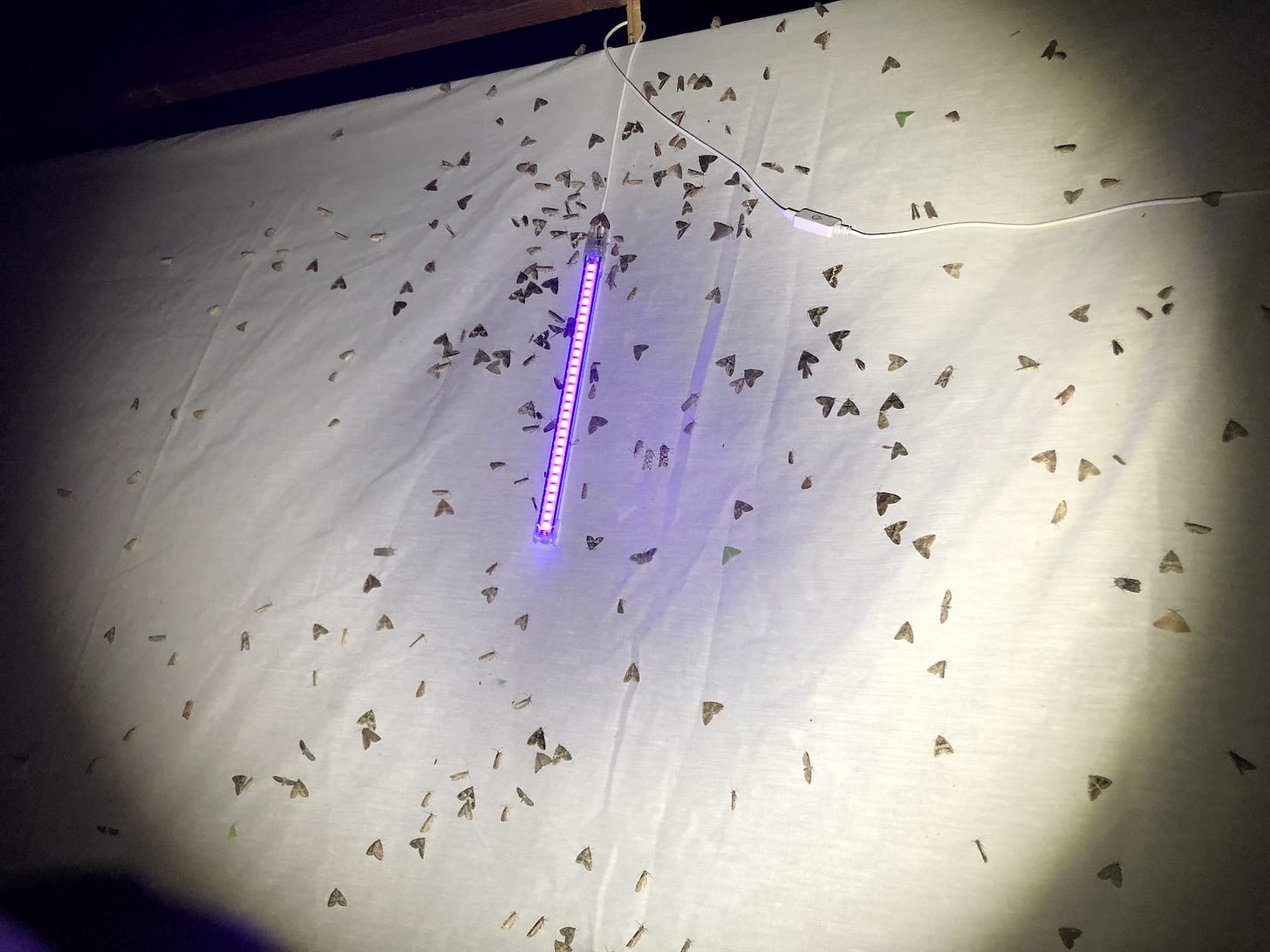
Stargazing not enough for you? Give Mothing a try. On a good night in a wooded area, with the power of a bed sheet and some light, you can enjoy the company of dozens of moths, beetles, lacewings, and other insects you’d never notice otherwise. Mothing requires zero skill or experience, just minimal gear. It’s a great way to learn more about the ecosystem in your area.
Getting Started
The gear list is short: a white bedsheet, a UV blacklight bulb, and something to power it. UV bulbs are available cheaply online or at hardware stores, and a basic battery-powered option means you don’t even need an outlet nearby! Hang the sheet between two trees or over a clothesline, shine the light on it, and wait. That’s it. Bring a regular flashlight for moving around in the dark, and avoid touching your eyes after handling insects. Set up away from sensitive vegetation, don’t leave the light running all night unnecessarily, and let everything fly off on its own when you’re done. Look, don’t take.
Bring the Kids!
Mothing is genuinely great with kids because the payoff is immediate. Moths are large enough to see clearly and strange enough to be exciting. Give them a field guide printout of common local moths and turn it into a scavenger hunt. The iNaturalist app is free and lets them photograph and identify what lands on the sheet, which adds a collecting element without taking anything home.
I hope you found this post helpful and inspiring! At the end of the day the most important thing is to get outside. What that means is entirely up to you. Whether you’re sketching, hiking, camping, stargazing, or simply bathing yourself in nature - the benefits are all the same.
More from
the field